This is a revised version of an article originally written on March 18, 2020.
Introduction
Understanding how our personality type influences resilience can transform how we respond to life’s challenges. Whether you’re navigating workplace stress, personal hardships, or societal disruptions, recognizing your natural tendencies provides valuable tools for building mental strength and adaptability. This article explores how different personality types, especially through the Myers-Briggs Type Indicator (MBTI) framework, affect our reactions to stress and offers actionable strategies to build resilience and adapt to challenging environments with greater self-awareness and compassion.
I’ve always felt a strong drive to help—whether in the classroom, on an ambulance, or in community response roles. Over the years, I’ve also learned that this desire can become a double-edged sword, sometimes leaving me drained when I fail to set boundaries.
Challenging environments, whether global crises, personal hardships, or day-to-day stressors, offer an opportunity. An opportunity to help each other grow, to observe and understand ourselves and those around us, and to develop tools that build resilience.
Understanding Our Personality Blueprint
In recent years, I’ve been exploring personality theory, especially my own tendencies. I am an INFJ, according to the Myers-Briggs Type Indicator (MBTI), and a Highly Sensitive Person (HSP). This means solitude and introspection come easily to me, while high-stimulation environments can quickly feel overwhelming.
However, not everyone experiences the world this way. While alone time rejuvenates me, my extroverted friends and family thrive on connection and external stimulation. Understanding these differences has helped me navigate my own stress response and empathize with others more effectively.
As an educator, this insight proved invaluable. Some students blossom in group activities, while others thrive with independent reflection. Recognizing these preferences helps create more supportive environments—whether in the classroom, workplace, or at home.
Figure 1
16 personality types chart.
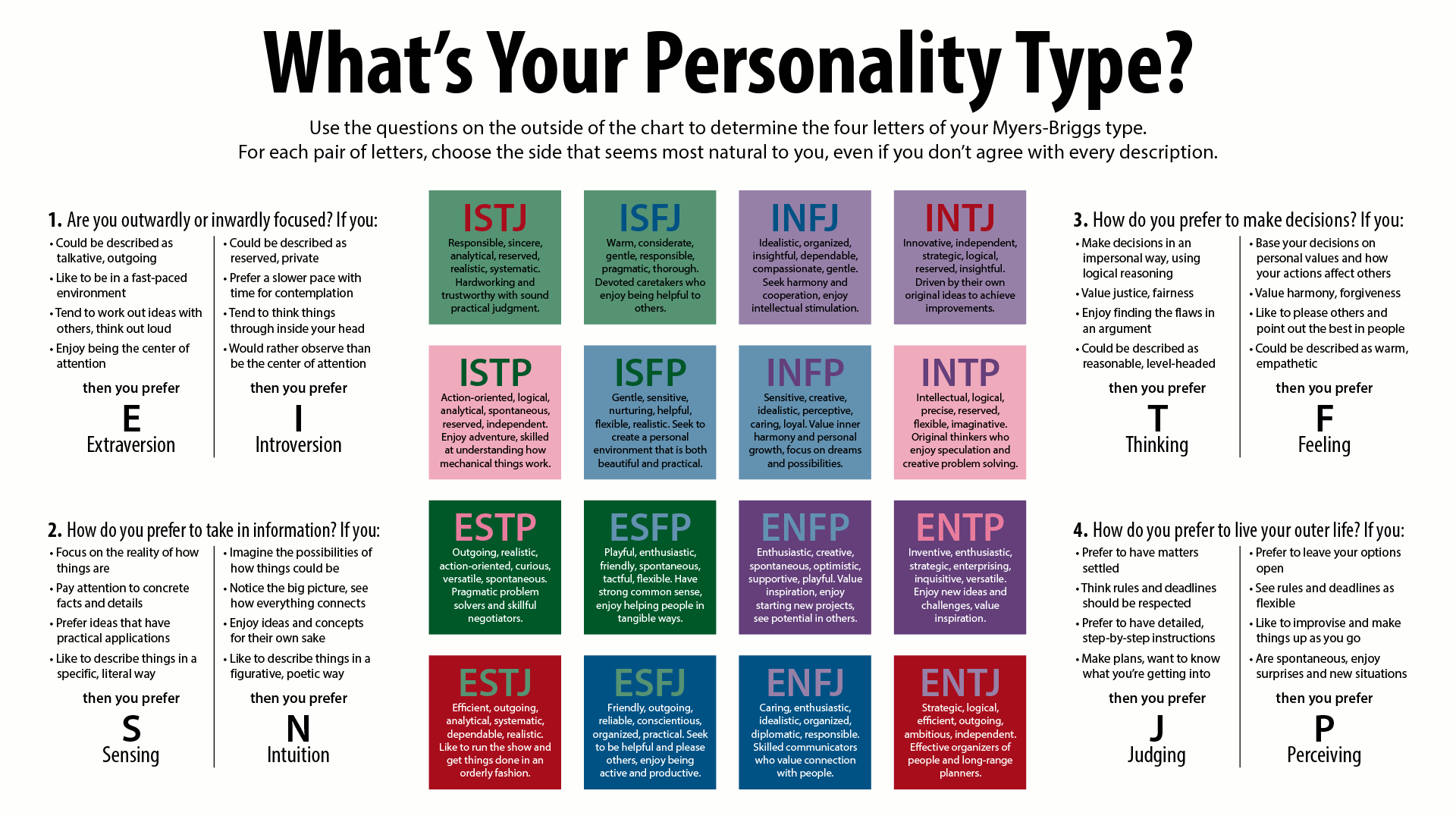
Note. 16 Myers-Briggs personality types chart. From Myers–Briggs Type Indicator, by Wikipedia contributors, n.d. https://en.wikipedia.org/wiki/Myers%E2%80%93Briggs_Type_Indicator#/media/File:MyersBriggsTypes.png. Licensed under CC BY-SA 4.0.
Growth Beyond Our Comfort Zones
Carl Jung’s foundational psychological theories highlight that each of us has innate preferences for how we process the world (Jung, 1971). Modern research has expanded on this, showing that leaning exclusively on our strengths can limit personal growth. As Lenore Thomson (1998) notes, we often focus on skills that come naturally while neglecting those that challenge us.
Neuroscience also supports this perspective. Studies show that every time we engage in a new mental function, we strengthen neural pathways, building mental flexibility and resilience (Thomson, 1998).
By stepping beyond our comfort zones—whether that means seeking quiet moments of reflection or practicing social engagement—we increase our adaptability in the face of adversity.
Why This Matters
We cannot always control the challenges we face, but we can influence how we respond. By understanding personality dynamics—our own and those of people around us—we can foster resilience and growth.
Take some time to reflect:
- What environments leave you feeling energized or depleted?
- How do the needs of your loved ones differ from yours?
- What small changes could you make to build more flexibility and resilience?
Learning about personality traits isn’t just an intellectual exercise; it’s a tool for navigating life’s inevitable ups and downs with greater compassion and awareness.
Creative Commons Note
Some images in this article are used under the Creative Commons Attribution-ShareAlike 4.0 International License (CC BY-SA 4.0). This license allows free sharing and adaptation of content, as long as proper attribution is given and any derivative works are shared under the same license. This helps make educational resources more accessible and promotes knowledge sharing while respecting creator rights.
References
Aaron, E. (n.d.). The Highly Sensitive Person. Retrieved March 18, 2020, from https://hsperson.com
Jung, C. G. (1971). Psychological Types. Princeton University Press.
Thomson, L. (1998). Personality Type: An Owner’s Manual: A Practical Guide to Understanding Yourself and Others Through Typology. Shambhala Publications.
16 Personalities. (n.d.). Personality Types. Retrieved March 18, 2020, from https://www.16personalities.com/personality-types
Wikipedia contributors. (n.d.). Myers–Briggs Type Indicator. Wikipedia. Retrieved July 15, 2025, from https://en.wikipedia.org/wiki/Myers%E2%80%93Briggs_Type_Indicator#/media/File:MyersBriggsTypes.png
Author: Brigitte Denton (Founder of Beyond Limits Education)